Several years ago, my teenage daughter boasted to me about the large number of “friends” she had on Facebook – people who “liked” her. But when she went through a particularly difficult trial a few months later, virtually all her friends were nowhere to be found. She learned the hard way that quality of friendship is vastly superior to quantity of friendship.
A naive teenager can be forgiven for this lack of judgment. But how about those of us who are adults? Are we doing any better at establishing, nurturing and protecting deep, meaningful friendships?
The majority of our waking day is spent at work, so a majority of our “friends” tend to have some connection to our professional network. If you are fortunate (and wise) enough to spend several hours with your family after work, then you should consider yourself blessed. So between work and family, where do we fit in real, authentic, lifelong friendships?
We don’t, unless we exercise radical intentionality. In this day and age when the tyranny of the urgent supersedes the priority of the important, we have to fight to make time for the friends who matter.
An honest inventory of our lives would ask, “What kind of friendships consume the majority of my time?”
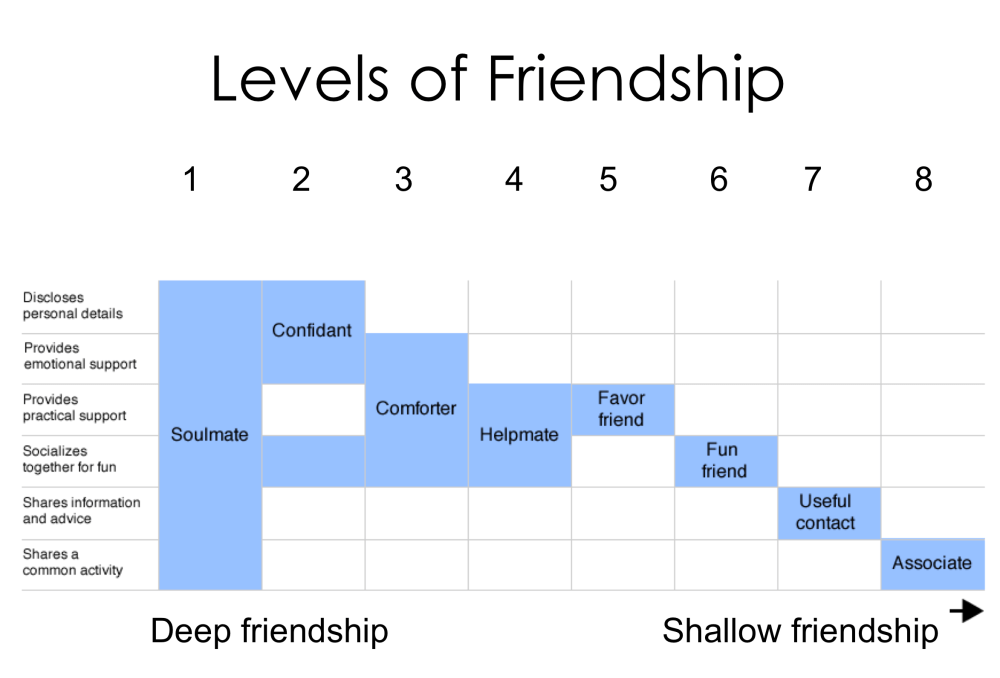
In their book on friendship, “Rethinking Friendship: Hidden Solidarities Today,” Liz Spencer and Ray Pahl conducted a great deal of research that resulted in identifying eight different types of friendships. They created a scale that runs from “simple” to “complex” friendships, but I’ve taken the liberty to redefine these as “shallow” to “deep” friendships – with Level 8 being the most “shallow” and Level 1 being the “deepest.” The nearby chart is a helpful visual aid.
Level 8: These people are Associates, men and women with whom we share a common activity, like a friend in the workplace, or someone who shares our passion for a particular avocation, like running, a hobby or charitable activity.
Level 7: These are the Useful contacts, folks who share information and advice, typically related to work or advancing one’s career. Think about the people you meet at networking cocktail parties or professional conferences. These folks like to divulge information, like an interesting article or opinion piece about some current event. They use facts and figures to keep the conversation going. These friendships are no deeper than watching CNN or listening to NPR.
Level 6: Your Fun friends are people who socialize together, but only for fun. They’d rather not know about your struggles or health problems; it’s TMI (too much information). They just want to party and forget about the real world for a few hours. Don’t expect any emotional support from these people. They are more-than-likely self-absorbed with their own hang-ups.
Level 5: Favor friends are people who help each other out in a functional manner, but not in an emotional manner. They might be a neighbor who lends you his lawn mower or takes your kids to school when you are sick. In my town of Washington, DC, these are the folks who deliver political favors and expect to cash in on those “chits” at a later time. These are friends with strings attached. Proceed with caution.
Level 4: Your Helpmates are a combination of favor friends and fun friends. These are the folks you socialize with who are glad to help, but only when it’s convenient. They’ll give you a ride home if you missed the bus, but don’t expect them to do it too often.
Level 3: Now we’re getting into the deep end of the pool. Comforters are like helpmates who give of their time, but they also provide emotional support by listening and caring about what you have to say. They aren’t using you for their personal ends; they have too much integrity for that.
Level 2: Confidants disclose personal information to each other, even if it’s not especially flattering. These are the people with whom you feel safe and can trust with your deep, dark secrets. C.S. Lewis, the Oxford and Cambridge don, said, “Eros will have naked bodies; friendship naked personalities.” A confidant is the person with whom you can be emotionally naked and unashamed, because you can trust yourself to these people. They love you, warts and all.
Level 1: The very best friend to have is a Soulmate. These people display all six of the elements (far left column) in Spencer’s and Pahl’s chart. Who are these people? Ideally, they are your spouse or best friend. They are the people you can call at four in the morning about anything. These are the friends who walk in when the others walk out. These are the friends who will get in your face and say, “Your relationship with that hot woman in your office is sabotaging your marriage and family. End it. Now!” King David wrote in Proverbs 27:6 – “The wounds of a friend can be trusted.” What does that mean? It means a real friend will tell you what you don’t want to hear because it hurts, but you need to hear because it’s life saving. Level one friends are the people who will be crying at your funeral.
Let me make this a little more personal and ask, if I may, what kind of friend do you aspire to be? Jesus said, “There is no greater love than this: that a man would lay down his life for his friends.” If you think this sounds a little dramatic or unrealistic, then maybe you should talk to some Navy SEALs, Green Berets or missionaries. They’ve already decided that they would sacrifice their lives for their friends, and many have proven it in action. Aside from your family, is there any friend you would die for?
So it comes to this. We only have so many years, months, weeks or days left in our life. The clock is ticking. It’s not too late to jettison some shallow “friendships” to invest quality time in deeper, authentic relationships. As someone once said, “The right friends will always lead you down the right path.” May we choose our friends wisely.
# # # #
Michael Wm. Schick is President of Crossbow Creative, a former press spokesman for the President Pro Tempore of the US Senate, and author of “God’s Job, Our Job.” He lives and works in the “La La Land” known as the Washington, DC area.

This article first appeared in the May 2014 edition of PathNorth Monthly Musing
http://pathnorth.com/news-media/monthly_musings/pathnorth-monthly-musing-may-2014

 michaelwmschick
Excellent analysis!